

API Design, Security & Operations
Ship APIs another team can trust
For backend developers shipping APIs that are inconsistent, undocumented, or insecure — and the tech leads trying to set a standard. Any stack, with a Laravel-flavoured default path throughout.
The problem
Sound familiar?
Every endpoint in your API is a slightly different shape — clients write three error parsers and still get surprised.
Your “documentation” is a Postman collection from six months ago that no longer matches the code.
You’re pretty sure the API is secure, but nobody has actually tried to break it.
You shipped v2 by editing v1 in place, and a client you forgot about went down.
What you leave with
What you walk away with
Not notes — artifacts you built yourself, ready to use on Monday.
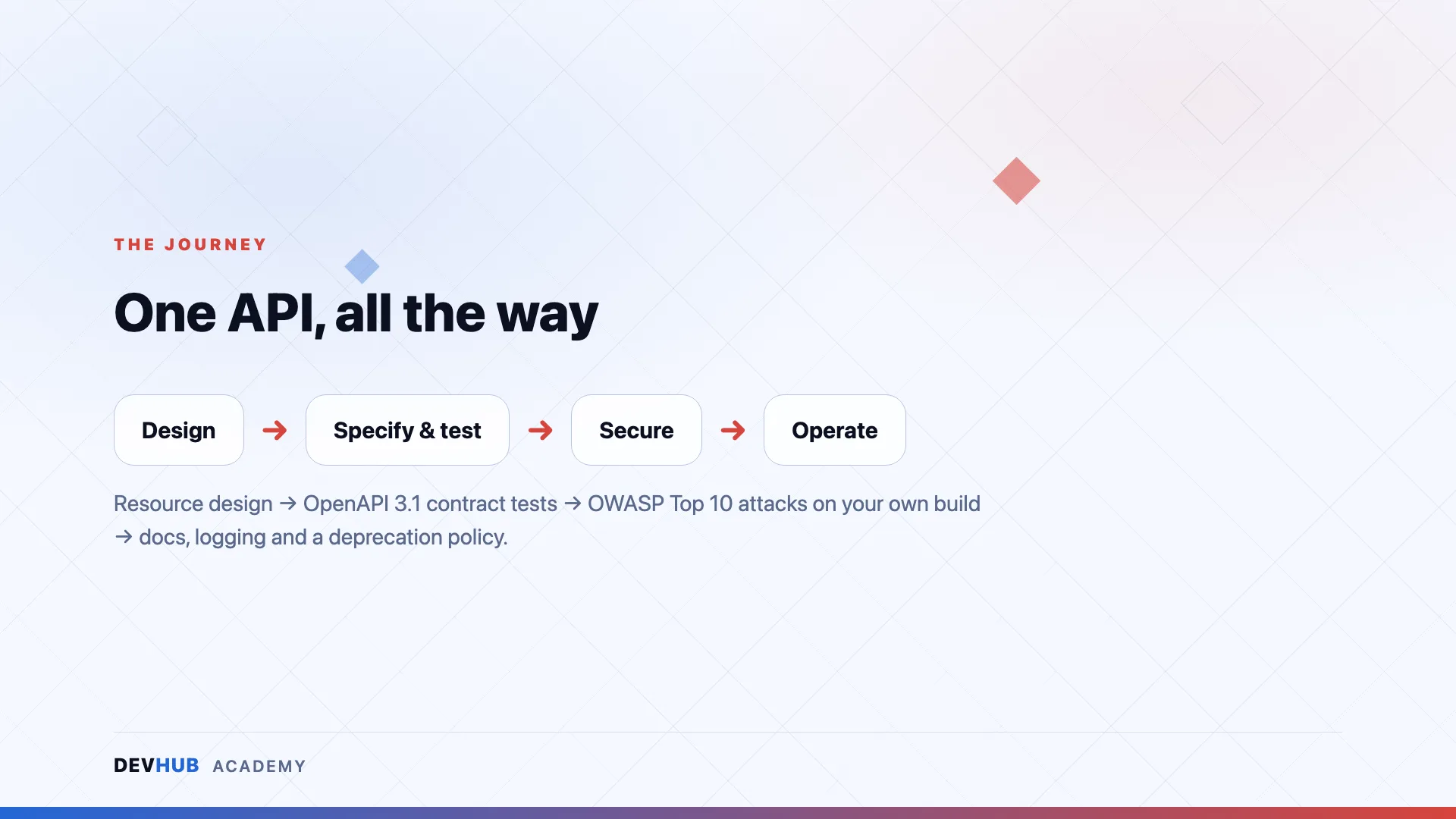
A running demo API with consistent resources, status codes, pagination, RFC 9457 errors, and versioning
An OpenAPI 3.1 spec that a passing contract-test suite enforces
The same API secured — token + OAuth2 auth, your own OWASP Top 10 attacks and fixes, rate limiting
Generated docs, request logging, and a written deprecation policy
A completed API standards one-pager your team can adopt on Monday
The proof
Why this course delivers
3.1
OpenAPI spec, contract-test enforced
Top 10
OWASP attacks on your own API
1
standards one-pager for your team
The curriculum maps to public standards you can verify: OpenAPI 3.1, RFC 9457, OAuth2, and the OWASP API Security Top 10 (2023)
Every participant attacks their own lab API through the OWASP Top 10 and fixes each finding — hands-on, not a slideshow of CVEs
Built by a practitioner who ships production Laravel APIs and open-source packages
Questions
Frequently asked
Who is API Design, Security & Operations for?
For backend developers shipping APIs that are inconsistent, undocumented, or insecure — and the tech leads trying to set a standard. Any stack, with a Laravel-flavoured default path throughout.
What do I walk away with?
Artifacts you built yourself, not notes — including:
- A running demo API with consistent resources, status codes, pagination, RFC 9457 errors, and versioning
- An OpenAPI 3.1 spec that a passing contract-test suite enforces
- The same API secured — token + OAuth2 auth, your own OWASP Top 10 attacks and fixes, rate limiting
Is this training hands-on or lecture-based?
Hands-on. Our trainings are taught by practitioners who ship production software daily — you spend the sessions building, breaking and fixing real things, not watching slides.
Is it delivered online or in person?
Delivery format and duration are decided per run — some runs are physical, some online. The details for each scheduled session are announced when registration opens.
How do I register, and how much does it cost?
Dates, venues and pricing are announced with each run. Hit “Get Notified” and you’ll be first in line when registration opens.
Ready to take a seat?
No run scheduled yet? Get notified and be first in line when registration opens — dates, venue and pricing land in your inbox first.